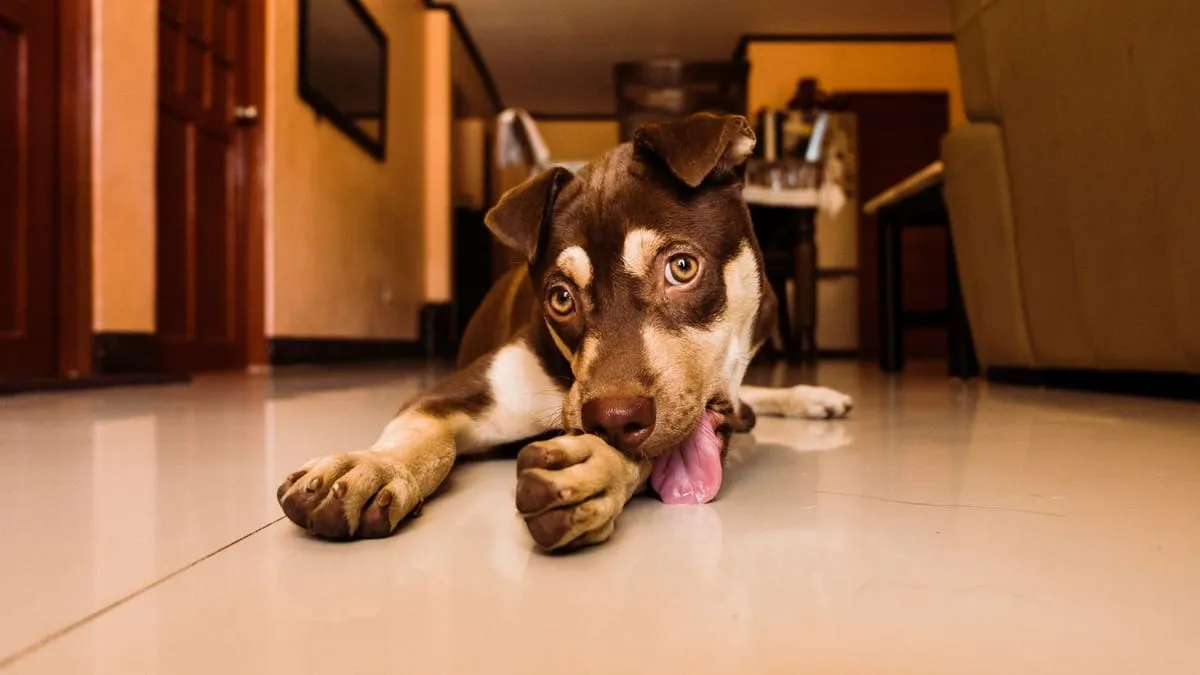
A dog cleaning off mud after a walk is not a problem. A dog that keeps coming back to the same paw, working at it between the toes for minutes at a stretch, staining the fur a rusty pink-brown with saliva, is doing something else entirely. Paw licking has a short list of usual causes, and most of them are findable if you know where to look rather than something you just have to live with.
I am a writer, not a vet, and skin and paw problems are genuinely one of the areas where a proper look, and sometimes a scraping or a swab, tells you far more than guessing at home ever will. What follows is how to narrow things down and what is worth checking yourself before that visit.
Start by actually looking at the paw
Before you think about allergies or anxiety, part the fur and look closely between every toe and across each pad, on the paw doing the licking and the others too.
You are looking for a grass seed or awn (a stiff, barbed grass head that works its way into the skin and keeps travelling once it is in, sometimes visible, sometimes not), a thorn or splinter, a cut or a torn nail, redness or swelling in one spot, or a lump between the toes that could be an interdigital cyst, a painful, often fluid-filled swelling that forms when a hair follicle or gland gets blocked or infected. Any of these gives a dog a very good reason to lick one paw obsessively, and none of them gets better with more licking.
If one paw is swollen, hot, has a visible wound, or your dog is limping or holding it up, that is a vet visit rather than a wait-and-see, whatever else might also be going on.
When it is more than one paw: allergies
If the paw check comes up clean and more than one paw is involved, allergies are the next and most common suspect, and they are worth understanding properly rather than just calling it “sensitive skin.”
A dog’s paws are thin-skinned and spend all day in direct contact with the ground, which makes them one of the first places an allergic dog reacts. Environmental allergies, to pollen, grass, dust mites or mould, often show up as licking that tracks with the seasons or gets worse after time outside, sometimes alongside a dog rubbing its face or licking its belly and flanks too. Food allergies tend to be less tied to season and more constant, and usually need a proper elimination diet, done under veterinary guidance, to actually identify the trigger rather than guessed at by switching bags of food at random. Our guide to why your dog won’t stop scratching covers the wider allergy and skin picture in more depth if paw licking is one symptom among several.
Allergic paws often get a secondary yeast or bacterial overgrowth once the skin barrier is disrupted by all the licking, which is its own smell, a musty, corn-chip sort of odour, and its own reason to see a vet rather than keep treating it at home.
When it looks more like boredom or anxiety
Once medical causes are genuinely ruled out, paw licking can be behavioural, a dog licking from boredom, stress, or as a self-soothing habit that has become a groove worn into the day.
This kind of licking tends to happen at predictable times, when a dog is left alone, during a quiet evening, or after something stressful, rather than following a physical pattern like one sore toe or a seasonal flare. It can also start as the tail end of a healed injury or a settled allergy, the original itch is gone but the licking habit outlasted it. More enrichment, a predictable routine, and addressing any underlying anxiety usually helps here, alongside the same steps in our guide to keeping an anxious dog calm if the licking clusters around time alone.
What actually helps in the meantime
While you work out the cause, a few things genuinely help without masking a problem you still need to find.
Wipe paws down after every walk, particularly in wet or grassy weather, since removing pollen, dirt and moisture before your dog has a chance to lick it off themselves cuts down on both the allergen exposure and the habit of licking. Antiseptic wipes are useful for a paw that is already a bit irritated, keeping it clean between vet visits without the dog needing a full bath. Keep nails trimmed and fur between the pads tidy, since overgrown fur traps moisture and debris exactly where seeds and irritants collect. And resist the urge to bandage a licked paw yourself for more than a short spell, a dog will usually just redirect the licking to the edge of the bandage or another paw entirely, so it treats the symptom without ever answering the actual question the licking was asking.
So, why does your dog keep licking his paws? Somewhere between something physically stuck or sore, an allergy showing up where the skin meets the world every day, or a habit that has outlasted whatever started it. Work through them in that order, check the paw first, and you will usually find the answer well before it becomes the harder problem of a wound that will not heal because the licking itself has become the injury.
Common questions
- Why does my dog keep licking one paw more than the others?
- Focusing on a single paw usually points to something local rather than a whole-body cause, a grass seed or thorn lodged between the toes, a small cut, a sore nail, or an interdigital cyst. Check between the toes and the pads carefully, and if you cannot find or clear whatever is there, or the paw looks swollen or the dog is limping, see your vet.
- Can allergies really make a dog lick its paws?
- Yes, and it is one of the most common causes. Paws are thin-skinned and pick up allergens directly from the ground and air, whether that is pollen and grass in an environmental allergy or an ingredient in the food in a food allergy. Allergic licking is usually on more than one paw, often comes with licking the belly or rubbing the face too, and tends to follow a pattern, a certain season or after a food change.
- Is it normal for a dog to lick its paws after a walk?
- A brief clean-up lick after a walk, especially somewhere muddy, wet, or gritty, is completely normal grooming and nothing to worry about. What is worth watching is licking that goes on for minutes at a time, happens away from walks, or has left the fur stained, damp, or the skin sore, since that has moved past ordinary grooming.
- When should I take my dog to the vet for paw licking?
- Book a visit if the licking is constant or worsening, if you can see redness, swelling, discharge, staining, hair loss, or a wound between the toes, if your dog is limping or holding the paw up, or if the licking is not settling despite you having ruled out the obvious things. Persistent licking is uncomfortable for the dog even before it becomes an infection, so it is worth acting on rather than waiting it out.