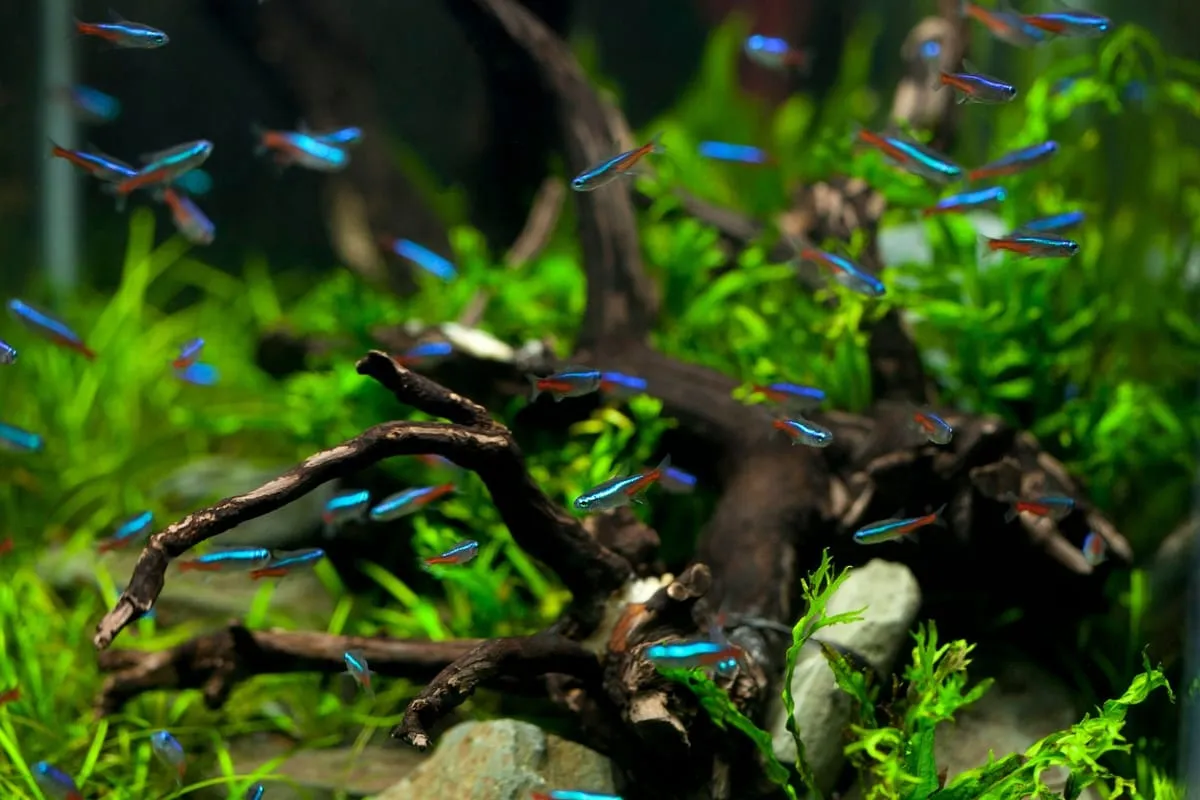
The neon tetra is the fish most people picture when they think of a tropical aquarium, a small, electric-blue and red streak sold cheaply in nearly every pet shop. That low price and easy availability create a false impression that neon tetras are a throwaway starter fish that will do fine in whatever tank is going. In reality they are a genuine schooling species with real requirements around numbers, water stability, and cycling, and getting those wrong is why so many neon tetras die within weeks of coming home. Get the basics right and they are a hardy, long-lived, genuinely beautiful centrepiece for a community tank.
A school, not a handful
The single biggest mistake with neon tetras is buying too few, and it changes everything about how the fish behaves.
Neon tetras are a shoaling species that lives in large, tight groups in the wild, and that instinct does not switch off in a tank. Kept as one, two, or three fish, a neon tetra is a stressed, insecure animal that hides, loses its vivid colour, and is generally miserable, whatever the tank around it looks like. A proper school of at least six, ideally more, is what lets the fish relax into normal shoaling behaviour, and it is also when the species actually looks like the electric display it is sold as. This means buying tetras is really a decision about tank size from the start, since six or more small fish need a tank sized to comfortably hold that number plus any other community fish, not a small bowl or nano cube stretched to its limit.
Stable, cycled, warm water
Beyond numbers, neon tetras are noticeably less forgiving of poor water conditions than some tougher community fish, which makes the basics matter more, not less.
A neon tetra tank needs to be fully cycled before the fish go in, exactly as covered in why fish keep dying, since an uncycled tank exposes a sensitive schooling fish to the ammonia and nitrite spikes that are a leading cause of early deaths. It also needs a reliable heater holding a stable tropical temperature, because neon tetras come from warm South American rivers and streams and do not do well in a cold or fluctuating tank, and regular water changes and testing with a proper test kit, along the lines of water changes and testing explained, keep conditions steady over time. Sudden swings in temperature or water chemistry hit neon tetras harder than they hit hardier fish like goldfish, so consistency is the goal, not just getting the numbers right once at setup.
Tankmates and the disease to know about
Neon tetras generally do well in a peaceful community, but two things are worth understanding before you add them to a mixed tank.
They are peaceful, small, and easy to house with other calm, similarly sized community fish, avoiding boisterous or nippy species that will stress or injure them, and a well-planted tank with some open swimming space suits their natural shoaling behaviour well, as it gives them cover while still leaving room to move as a group. The other thing to know is neon tetra disease, a specific and serious parasitic illness that causes fading colour, a curved spine, and wasting, and for which there is no cure. It is most often introduced through new fish, so quarantining new arrivals before adding them to an established tank, and buying from a source with healthy, active-looking stock, are the best real protection. An affected fish should be isolated promptly to protect the rest of the school, and any reptile-style assumption that a common, cheap fish must be hardy against everything does not hold here.
Who neon tetras suit
Put together, neon tetras reward a keeper who treats them as the real schooling fish they are rather than an afterthought species.
They suit someone setting up, or already running, a cycled, heated community tank large enough for a school of six or more, who is willing to do the water changes and testing that keep conditions stable, and who buys from healthy stock and quarantines new fish sensibly. They are a poor fit for a small, uncycled tank, or for anyone wanting just one or two fish to sit alongside an unrelated species without the numbers a school needs. Done properly, a shoal of neon tetras moving together through a planted tank is one of the most genuinely striking sights in the hobby, and far removed from the sad, faded singles too often seen in badly set up tanks.
Cheap and common should not be mistaken for undemanding. A neon tetra kept in a proper school, in a stable, cycled, heated tank, with sensible quarantine habits for new fish, is a hardy and long-lived addition to a community aquarium, and one that shows exactly why it became the fish everyone pictures when they imagine a tropical tank in the first place.
Common questions
- How many neon tetras should I keep together?
- At least six, and more is better. Neon tetras are a schooling fish that becomes stressed and washed out in colour when kept alone or in twos and threes. A proper school of six or more, in a tank sized for that many, is what actually settles them and shows off their colour.
- Do neon tetras need a heater?
- Yes. Neon tetras come from warm South American waters and need stable tropical temperatures, not an unheated room-temperature tank. A reliable heater keeping the water in the correct tropical range is essential, the same as for any tropical community fish.
- Why do my neon tetras keep dying?
- The most common causes are an uncycled tank, water that swings in temperature or parameters, and too small a school kept under stress. Neon tetras are also more sensitive than some community fish to poor water quality, so a fully cycled, stable, adequately sized tank matters more for them than for hardier species.
- What is neon tetra disease?
- A serious, incurable parasitic disease specific to tetras that causes fading colour, a curved spine, and wasting, usually spread from newly introduced fish. There is no treatment, so prevention through quarantine of new fish and buying from a healthy-looking stock is the only real defence. See your vet or an aquatic specialist if you suspect it, and isolate affected fish to protect the rest of the school.