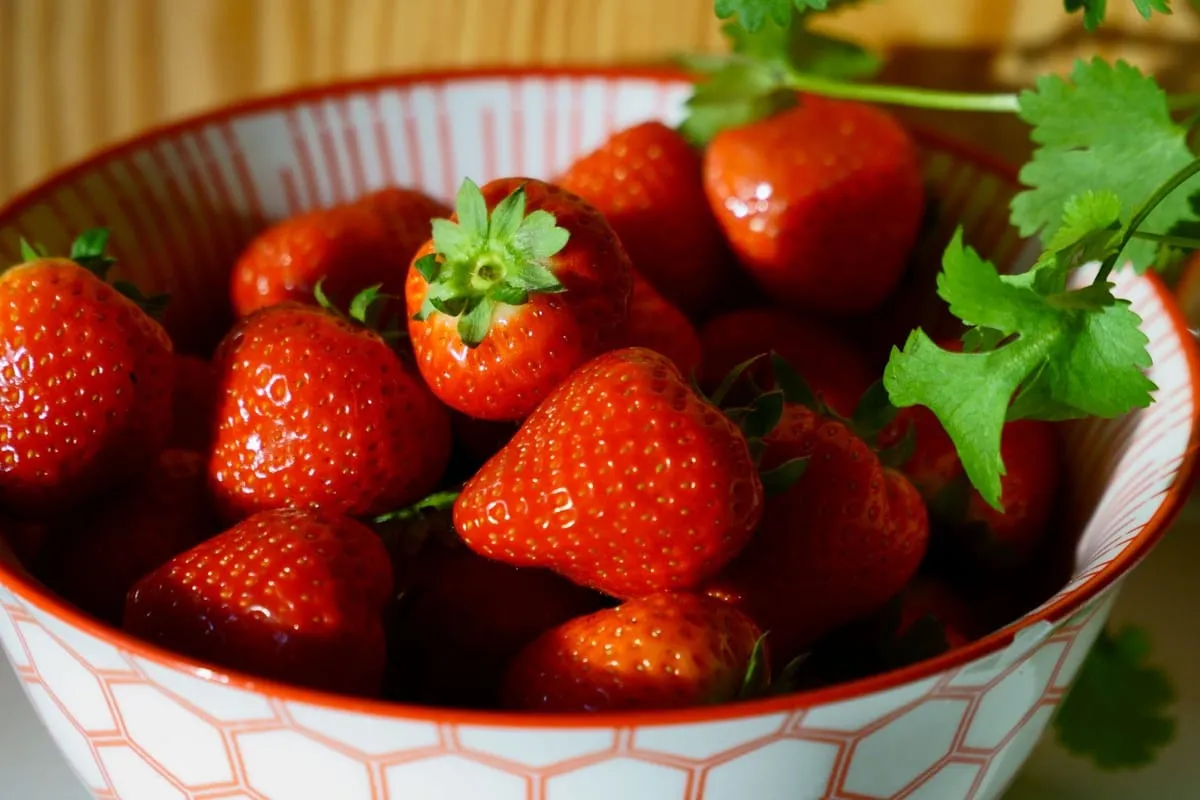
Yes, cats can eat a small piece of plain strawberry without harm, but it is worth being honest about why this question looks different for a cat than it does for a dog. Cats are obligate carnivores with no dietary need for fruit at all, and unlike dogs, they cannot taste sweetness. A strawberry is not a forbidden treat for a cat, it is closer to a novelty a cat happens to be able to eat safely, not one that does anything useful for it.
The short answer
A small piece of fresh, hulled strawberry is safe for the great majority of cats. It is not toxic, and an occasional taste is not something to worry about. What is worth knowing going in is that most cats have little interest, since cats lack the taste receptor for sugar that makes fruit appealing to us and to dogs. If your cat batted a strawberry off the counter and licked it out of curiosity, there is nothing to panic about. If your cat turns its nose up entirely, that is the more typical response.
Why most cats do not care
This is the part that makes strawberries a genuinely different question for a cat than for a dog, and it is worth understanding rather than just taking on faith.
Cats are obligate carnivores, built to get everything they need from meat, and over evolutionary time they lost the taste receptor gene that lets most mammals detect sweetness. Where a dog or a person tastes a strawberry and gets a hit of sugar that reads as reward, a cat tastes texture, water content and whatever surface aroma the fruit carries, and none of that reads as appealing the way meat does. Some cats are curious enough to lick or nibble a piece out of interest in something new on the counter, but genuine enthusiasm for fruit is unusual and, when you see it, it is more about texture play than taste. This is also why offering strawberries as a regular treat does not make much sense nutritionally. A cat’s diet should be built around a complete, balanced cat food formulated for an obligate carnivore, with fruit playing no real part in that.
How to serve it, if you offer any
If you want to let a curious cat try a piece, a little preparation avoids the two real risks, choking and stomach upset.
Wash the strawberry and remove the green leafy cap and stem, which are fibrous and not something a cat is well equipped to chew through cleanly. Cut the flesh into a small, soft piece rather than handing over a whole strawberry, since a cat is more likely to try to swallow a chunk than chew it properly the way a person would. One small piece, offered occasionally rather than as a habit, is enough. There is no reason to build strawberries into a cat’s regular diet, this is closer to letting a curious cat investigate something safe than offering a treat with any real value to it.
What to skip
Fresh, plain strawberry is the only form worth considering at all, and everything else strawberry-flavoured is better left out of a cat’s reach.
Strawberry yoghurt, jam, and flavoured syrups carry added sugar a cat gets no benefit from and cannot properly taste anyway, plus dairy that a fair number of adult cats digest poorly. Sugar-free versions of these products are a real concern, since some are sweetened with xylitol, which is dangerous for cats the same way it is for dogs. Chocolate-dipped strawberries are an outright no because of the chocolate. When in doubt, the plain fresh fruit with the cap removed is the only version of “strawberry” that belongs anywhere near a cat’s bowl.
When it becomes a problem
A cat that eats a modest piece of fresh strawberry is very unlikely to have any reaction at all. The more common issue, if there is one, comes from a cat getting into a larger amount than intended, a bowl left out or a punnet knocked off the counter, where the fibre and natural sugars can cause a loose stool or an upset stomach that usually settles on its own within a day. Watch for repeated vomiting, diarrhoea that does not clear up, or a cat that seems genuinely unwell rather than just mildly off, and call your vet if you see any of that, or if you know a strawberry product containing xylitol, chocolate, or a large amount of dairy was involved.
So, can cats eat strawberries? Yes, in a small amount of plain fresh fruit with the leaves removed, though do not be surprised if your cat is entirely unimpressed. For what else is genuinely safe or worth avoiding, see our guide to which human foods are safe for cats, and for other specific foods, our guides to grapes, chicken and eggs.
Common questions
- Can cats eat the green leaves or stem of a strawberry?
- Better to remove them first. The leafy cap and stem are not toxic in the way something like a grape is, but they are fibrous and harder to digest, and a piece can be a choking risk for a cat that swallows it whole rather than chewing it properly. Hull the strawberry the same way you would for yourself and offer just the soft flesh.
- My cat sniffed a strawberry and walked off. Is that normal?
- Very. Cats lack the taste receptor that responds to sugar, so a strawberry does not register as a treat the way it does for a dog or a person. Most cats show mild curiosity about the smell or the texture and then lose interest, which is a completely normal response, not a sign anything is wrong with the fruit or the cat.
- Can cats eat strawberry yoghurt, jam or flavoured treats?
- These are a different food from fresh strawberry and worth treating with more caution. Flavoured yoghurt and jam carry added sugar and sometimes xylitol in sugar-free versions, which is genuinely dangerous for cats, plus dairy that some cats handle poorly. Skip processed strawberry products and stick to a small piece of the real fruit if you want to offer any at all.
- How many strawberries can a cat eat?
- A cat has no nutritional need for strawberries at all, so there is no target amount to aim for. If you do offer some, one small diced piece once in a while is plenty. There is no benefit to giving more, and a cat that eats a larger amount of any fruit at once is more likely to end up with a loose stool from the fibre and natural sugars than to gain anything from it.