A tank that looked clear yesterday and looks like weak tea or pea soup today is alarming, especially when nothing obvious has changed. The good news is that cloudy water almost always narrows down fast once you look at the actual colour of the haze, because white, green, and brown cloudiness each point to a different, fairly predictable cause with its own fix.
What the colour is telling you
A white or grey, milky haze is a bacterial bloom, by far the most common cause and the one most new owners run into first. A green tint, ranging from a faint wash to something closer to pea soup, is a free-floating algae bloom. A brown or yellow tinge is usually either tannins leaching out of driftwood or decorations, or fine debris and waste stirred up off the substrate. Working out which of the three you have before doing anything else saves you from treating the wrong problem.
White or grey haze, a bacterial bloom
This is the one that catches almost every new fishkeeper off guard, usually a few days to a couple of weeks after setting up a tank.
The bacteria that break down ammonia and nitrite are still building their population, and as that colony grows and overshoots before settling, huge numbers of free-floating bacteria cloud the water a milky white or grey. It is a normal, expected part of cycling a new tank, not evidence that something has gone wrong, and it typically clears on its own within one to two weeks as the colony stabilises.
The same bloom can also turn up in an already-established tank after a big feeding mistake, an overcleaned filter that lost too much of its bacteria colony, or a sudden jump in the number of fish. Bottled bacteria can shorten the settling period in either situation by seeding a working colony faster than waiting for one to grow from nothing.
Green water, an algae bloom
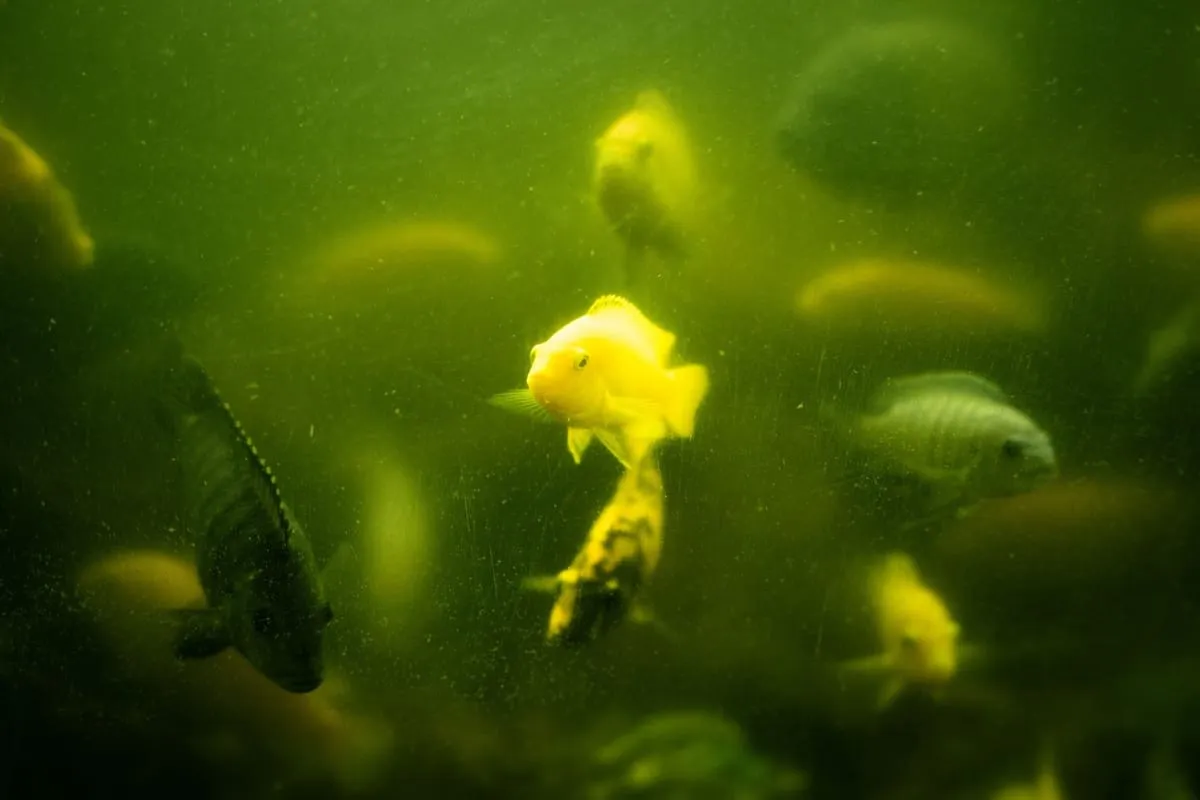
Green cloudiness is a different organism doing a similar thing, single-celled algae multiplying in the open water rather than on the glass or decorations.
It needs two things to bloom: light and nutrients, so it shows up hardest in tanks getting too many hours of light, sitting somewhere that gets direct sun, or carrying more fish waste and uneaten food than the tank’s plants or filtration can use up. Cutting the light back to six to eight hours a day, moving the tank out of direct sunlight, and feeding only what fish clear in a couple of minutes all reduce the fuel the bloom is running on.
Brown or yellow tinted water
Brown or yellow water is often the least worrying of the three, and sometimes not a problem to fix at all.
Driftwood and some other natural decorations leach tannins, the same compounds found in tea, which tint water a yellow-brown without affecting water quality. Many blackwater setups are kept this way on purpose. The other common cause is finer, less pleasant: settled waste, uneaten food, and debris on the substrate getting stirred up into the water column, which is more of a genuine cleanliness issue than a cosmetic one. A gravel vacuum during water changes, paired with a dechlorinator that also detoxifies ammonia for the fresh water going in, clears the debris version quickly. Tannin staining fades on its own over weeks, or faster with activated carbon in the filter if you would rather not wait it out.
When to actually worry
Ordinary new-tank haze and the occasional algae bloom are a normal part of running a tank, and the fix is patience plus the steps above, not panic. What deserves real concern is cloudiness that drags on for weeks despite water changes and reduced feeding, cloudiness that arrives alongside fish that keep dying or acting unusually stressed, or any smell that is genuinely bad rather than just the normal earthy scent of an aquarium. Those combinations point to a water quality problem that testing will confirm, not something to wait out.
The fast version
Look at the colour first. White or grey almost always means a bacterial bloom that clears with time and testing, not a big water change. Green means an algae bloom that needs less light and less feeding, plus a UV sterilizer if it will not quit. Brown or yellow is usually harmless tannins or debris that a gravel vacuum sorts out. Test the water whenever you are unsure, since that is what actually tells you whether a cloudy tank is a normal phase or a problem that needs fixing now.
Common questions
- What causes cloudy water in a new fish tank?
- Almost always a bacterial bloom. The colony of bacteria that breaks down fish waste is still establishing itself, and the population overshoot that happens along the way turns the water a temporary white or grey haze. It is a normal part of cycling a new tank, not a sign that anything has gone wrong, and it usually clears on its own within one to two weeks.
- Is cloudy fish tank water dangerous to my fish?
- It depends on the cause more than the cloudiness itself. A white or grey bacterial bloom in a cycling tank is not directly harmful, but it often shows up alongside rising ammonia or nitrite, so testing the water rather than just watching the haze is the safer move. A sudden cloud paired with a strong smell, dying fish, or fish gasping at the surface is a different situation and needs checking immediately.
- How do I get rid of green water in a fish tank?
- Cut the light first, since green water is an algae bloom feeding on light and excess nutrients. Reduce how many hours the tank light runs, stop overfeeding, and do smaller, more frequent water changes rather than one big one. Algae spores survive a normal water change easily, so a single change rarely clears it, and a persistent bloom often needs an inline UV sterilizer to actually knock the free-floating cells down.
- Will a water change fix cloudy water?
- Sometimes it helps, but it treats the symptom rather than the cause. A water change dilutes a bacterial or algae bloom for a day or two, but if the tank is still cycling, still overfed, or still getting too much light, the cloudiness comes straight back. Identify which of the three main causes you actually have before deciding what to do next, since each one needs a different fix.